I approached this trading week with curiosity and a decent dose of apprehension… the two previous sessions (before the July 4th holiday) had left AI trade sentiment in the ICU's waiting room. It wasn't until mid-week that the first glimpse of relief diverted the patient to a lower-intensity observation ward.
I saw a market deflecting some of the recent geopolitical uncertainty, which, per se, can be read as a sign of resilience against the current backdrop of AI skepticism.
The markets fascinate me because they can do absolutely anything they "want to". Understanding this—and coming to grips with it—is not easy. But once you make peace with that idea, your focus shifts towards a more purposeful objective: how should I act in this environment, rather than trying to predict and justify every single "outlier" candle?
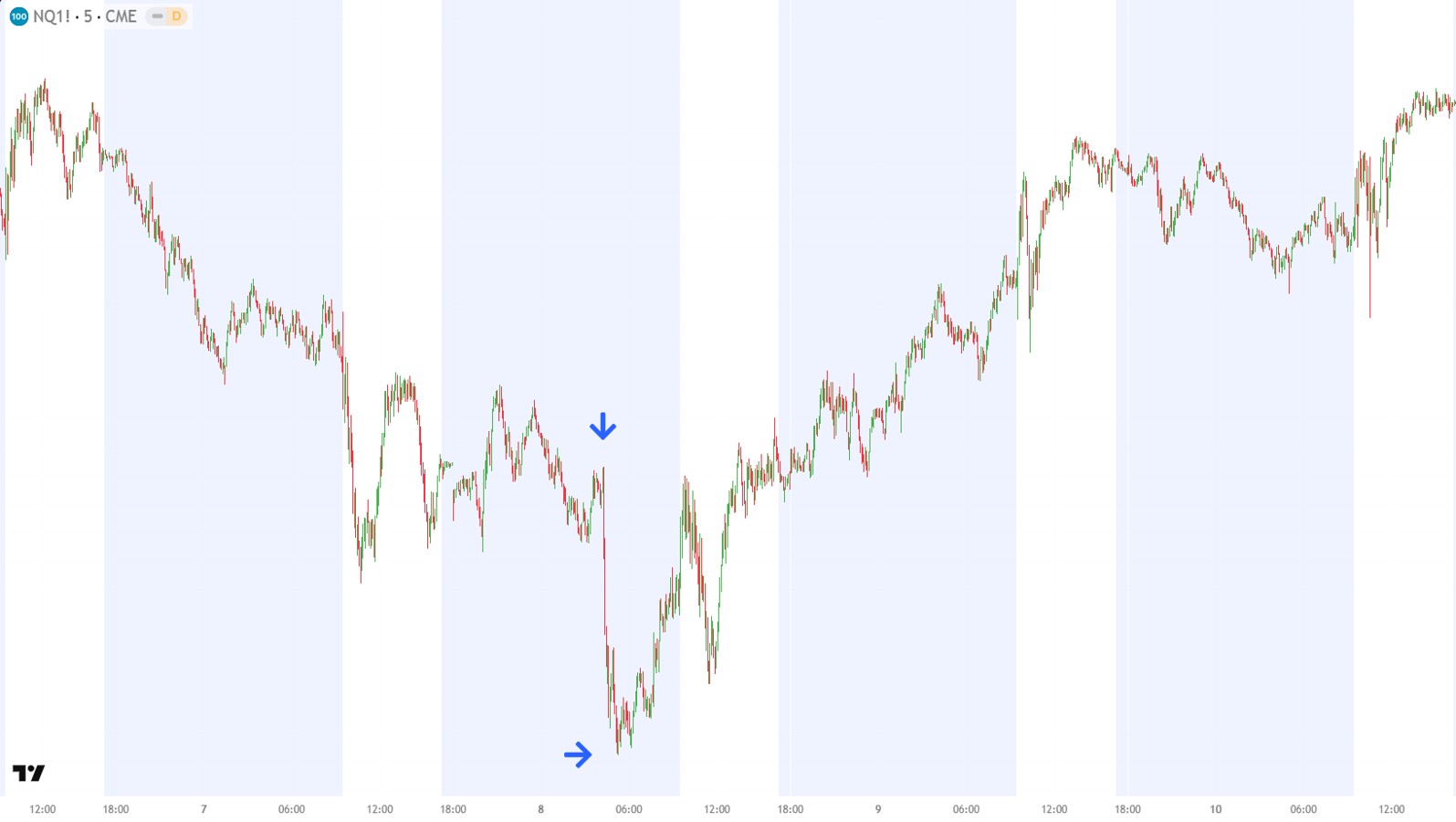
Midnight Blues
What unfolded during Tuesday-to-Wednesday night session was quite remarkable. We were hitting the lows of the week, compounding on a pretty bad, aka gap down Tuesday session, and despite this difficult backdrop, the markets found a way to resurface and open on a good note, paving the way for a much-needed turnaround Wednesday.
Winter VIX In July
Sometimes I tend to "forget" about Mr VIX. This week, though, it is worthwhile mentioning that amid peak anxiety during Tuesday-to-Wednesday night session, when the VIX briefly approached 19, it eventually fell back to levels not seen since mid-January, closing below 15.
For me, this is (just) another variable to help me put all the price action into perspective: we have been able to absorb the recent Korean shakeouts with some degree of success. The question now turns to the waves of earnings that are about to hit Wall Street shores for several weeks in a row.
Samsunomics Testing Support Levels
By the time Wall Street was having breakfast on Tuesday, the bad news from Korea had already been served: despite a spectacular preliminary earnings update, Samsung had sunk 7% and triggered yet another circuit-breaker in the Kospi.
This reminds me of what I have heard multiple times in an elite sports context: getting to the top is hard, staying there is harder.
Expectations are an important component of the price reaction to singular events like earnings releases. Market sentiment is another one, and right now the all-mighty memory cluster (be it DRAM, NAND or HBM), where Samsung plays a central role, is under intense scrutiny as pricing increases can potentially start harming demand in a more pronounced way.
Market Timing From SKorea With Hope
Not all Korean heavyweights were throwing uppercuts; in fact, SK Hynix, the other HBM player, may well have been the breath of fresh air the AI trade was looking for. Its venture into American soil, with the biggest equity offering (via ADR) of a foreign company, might have helped provide some upside-tinted consolidation during the final two sessions of the week.
Next Week From The Deck
With earnings season around the corner and already two big semiconductor players on deck for next week—the almighty Dutch monopolist ASML and Taiwan's foundry giant TSMC—the odds of international players once again sending ripples across Wall Street are certainly increasing.
I will also keep an eye on inflation numbers on Tuesday and have some homework to do… let me explain…
Synapses
At the end of the week, I found myself skimming through the recent price action of several key SOX constituents and, to my surprise, I could almost feel a few synapses firing.
One thing that caught my attention was just how differently some semiconductor names had behaved during the recent shakeout—far more so than I had previously assumed.
I don't know yet whether there's a meaningful pattern behind those divergences, but it was enough to spark my curiosity. Perhaps looking beyond the index—and into the different semiconductor subsegments—might reveal another layer of context that can help me better interpret price action across the semiconductor space.